The leave no trace guide: How to enjoy the outdoors without becoming the plot twist
Key Takeaways
Leaving no trace is less about heroic wilderness skills than making considerate decisions before, during, and after an outing. We can enjoy wild places generously without leaving the next visitor a mystery novel made of wrappers, trampled plants, and suspiciously warm campfire stones.
- Plan around local rules, weather, access, and likely conditions.
- Travel on durable surfaces and keep campsites small.
- Pack out every scrap, including food waste and hygiene supplies.
- Keep wildlife wild, fires modest, and natural objects where they belong.
- Treat mistakes as moments to adjust rather than excuses to give up.
What “leave no trace” really means
A leave no trace guide is not a list of wilderness purity tests. It is a practical way to reduce damage to land, water, wildlife, and other people while accepting that outdoor recreation is never completely impact-free. From a Tasmanian day walk to a long Australian camping trip, the useful question is simple: what can we do so the place remains healthy and welcoming after we leave?
The seven principles in plain English
The seven principles are straightforward: plan ahead and prepare; travel and camp on durable surfaces; dispose of waste properly; leave what we find; minimise campfire impacts; respect wildlife; and be considerate of other visitors. They are prompts for judgement, not magic words that make every decision automatic. A rocky alpine route, a sandy beach, and a damp rainforest each ask us to apply the same ideas differently.
Planning prevents avoidable trouble, while durable surfaces protect soil and plants from repeated footsteps. Waste should leave with us, wildlife should remain wild, and natural or cultural features should not become souvenirs. Fire deserves special caution in Australia, where a small ember can become a very large problem.
Why small impacts add up fast
One shortcut across a patch of vegetation may seem harmless, especially when the ground looks already a little worn. Repeated by dozens of walkers, though, that shortcut becomes a track that sheds water, widens, and invites still more feet. The same pattern applies to scraps of food, informal campsites, and stones rearranged around a fire.
Small choices become shared conditions when enough people make them. We may never see the cumulative result of our own visit, which is precisely why restraint matters. Good outdoor ethics often feel almost invisible: a closed gate, an undisturbed nest, and a campsite that looks as though nobody slept there.
The difference between legal and responsible
Rules establish a minimum standard; responsibility asks us to notice what the rule cannot cover. A site may permit fires, for example, while dry weather, scarce wood, or heavy use makes a fire a poor choice. A track may be open, yet a temporary closure or wet ground may make waiting wiser than pushing through.
We should check official local guidance and follow it, but we should also use judgement when conditions change. Legal access is not a licence to behave carelessly, and a sign cannot anticipate every muddy corner, nesting season, or crowded lookout.
How to adapt the principles to any environment
The principles travel well because they describe relationships rather than one particular landscape. In alpine country, snow may be the most durable surface; beside a creek, the sensible decision is to keep distance and protect the bank. On a popular coastal walk, concentrating use on established paths may be kinder than spreading footsteps across fragile dunes.
We can ask three questions wherever we go: what is vulnerable here, where are people already meant to travel, and what would be difficult for this place to recover from? Those answers give us a practical starting point without pretending every landscape works the same way.
Plan ahead before your boots hit the trail
Most low-impact decisions are made before we reach the trailhead. We need enough information to match our route, gear, timing, and group to the conditions rather than relying on optimism and one nearly charged phone. Preparation also makes the trip calmer, which leaves more attention for the actual landscape.
Researching rules, permits, and local conditions
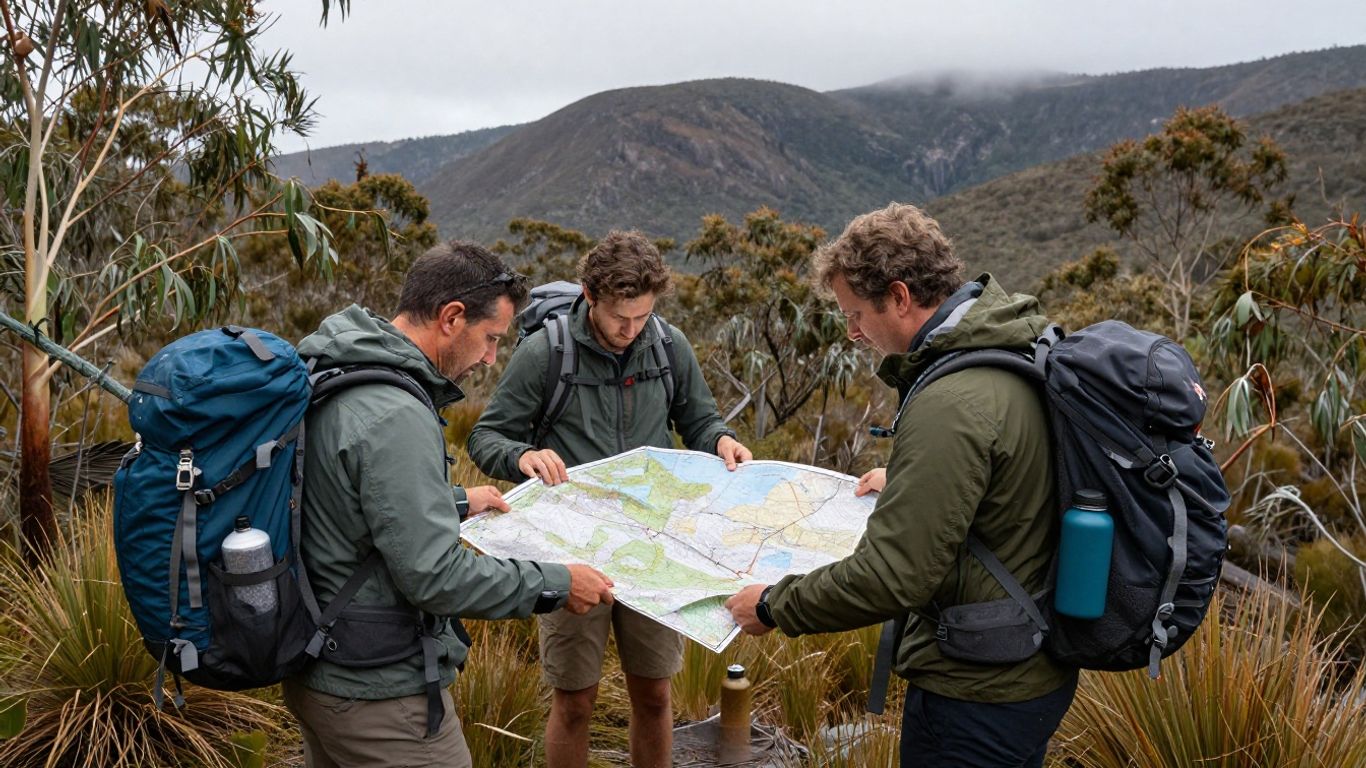
Before setting out, we should check the land manager’s current information for closures, permits, bookings, fire restrictions, toilets, dogs, vehicles, and camping areas. Weather forecasts are useful, but they are not a guarantee; Tasmanian conditions can turn brisk and wet while the car park remains deceptively cheerful. We should also tell someone our plan when the route is remote or conditions are uncertain.
Local knowledge matters because a familiar-looking track may cross private land, a protected area, or a place with seasonal restrictions. A few minutes of research can prevent an awkward retreat, an accidental trespass, or a rescue-worthy decision made in shorts and confidence.
Choosing durable routes and low-impact campsites
A durable route is one designed or naturally able to handle feet without widening or losing its surface. Established trails, rock, gravel, sand, dry grass, and snow can all be suitable in the right conditions, but none is a universal invitation to wander. We should select designated campsites where they exist and avoid creating new sleeping spots beside water or in vegetation.
Popular places usually benefit when we concentrate use on existing paths and sites rather than making a web of alternatives. In less disturbed country, spreading out may sometimes prevent one small area from becoming a permanent camp; local guidance should settle the question.
Packing for weather, crowds, and the unexpected
Packing well is environmental care with a zip. We should carry layers for changing weather, enough water, navigation tools, a first-aid kit, a light, and a way to manage our waste, while keeping food packaging simple. A little spare capacity helps us carry out rubbish we find without turning the pack into a travelling junk drawer.
Crowds also deserve planning. Starting earlier, choosing a quieter time, or splitting a large group can reduce pressure on tracks, facilities, and other visitors. The best route is not always the most dramatic one; sometimes it is the one our group can complete without improvising badly.
Building a waste plan before creating any waste
Waste is easier to manage when we decide where it will go before opening the muesli bar. Repacking food at home removes bulky wrappers, and a dedicated rubbish bag keeps crumbs, tissues, and damp odds and ends from migrating through the pack. We should bring only what we can carry out, including leftovers.
A useful pre-trip check is compact enough to remember:
- Carry a sealable bag for rubbish and food scraps.
- Pack toilet paper and hygiene supplies in a separate opaque bag.
- Confirm whether the route has toilets and what facilities are available.
- Bring a trowel only where local guidance permits catholes.
Once the plan is visible, waste stops being an embarrassing surprise at the car. We can concentrate on the walk rather than conducting a frantic pack audit at dusk.
Travel and camp on tough surfaces
The ground beneath us is not scenery with unlimited spare capacity. Plants, soil crusts, mosses, dunes, and creek edges can take years to recover from a few careless steps, particularly where rain and wind keep stripping the surface. We should let the landscape tell us where use can be concentrated and where it needs space.
Staying on established trails and durable ground
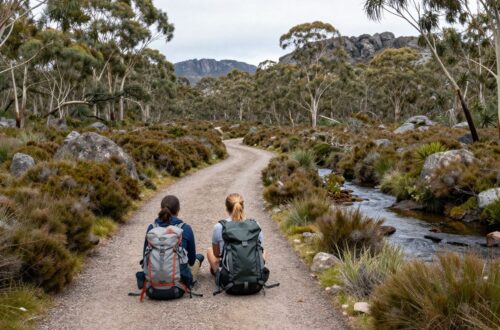
On a formed track, we generally stay on the trail even when it is muddy, walking through the mud rather than widening the route around it. Skirting a puddle often creates two new edges, and two new edges soon become a broad scar. If a track is closed or unsafe, we should turn back instead of inventing a parallel route.
At camp, we keep activity on already durable ground and avoid flattening plants for comfort. A tent footprint is not a moral exemption; it simply makes the area we use more obvious and manageable.
Handling mud, snow, desert crust, and fragile plants
Different surfaces need different behaviour. Snow can spread footsteps when it is deep enough, while thin snow over vegetation may conceal damage; wet alpine plants and desert crusts deserve a wide berth. Where there is no clear route, we should pause and check local guidance rather than assuming the most direct line is the least harmful.
The same care applies to river margins and coastal dunes. Water may seem like a shortcut, but banks and edges are often soft, erodible, or habitat-rich. Our boots are not villains, but they are remarkably persuasive when we point them in the wrong direction.
Picking a campsite without flattening the landscape
A good campsite is found rather than made. We look for an established, durable area that is large enough for our group, away from water and fragile vegetation, and not so close to another party that everyone shares one conversation by accident. We avoid moving rocks, cutting branches, or scraping a level platform.
Before leaving, we restore nothing that we had to alter because we should not have altered it in the first place. A sweep for cord, pegs, food, and tiny bits of packaging is more useful than a decorative rearrangement of the site.
Knowing when shortcuts are actually long-term damage
Shortcuts are tempting when we can see the destination and the official path appears to take the scenic route through our impatience. Yet a shortcut may cut across drainage lines, fragile plants, or a slope that erodes after repeated traffic. The few minutes saved can leave a route that future walkers mistake for the proper way.
When a route feels inconvenient, we can treat that inconvenience as information. Staying on the established line protects the landscape and makes navigation clearer for the people who come after us.
Dispose of waste like a responsible human
Waste management begins with the slightly unglamorous understanding that the bush is not a bin, compost heap, or helpful flatmate. Food scraps can attract wildlife, paper can blow into waterways, and so-called biodegradable items may persist when conditions are too cold or dry for quick breakdown. We carry out what we carry in, plus anything we accidentally drop.
Packing out trash, food scraps, and “biodegradable” items
Wrappers, fruit skins, tea bags, tissues, and leftovers all belong in our rubbish bag unless a facility clearly says otherwise. Organic does not mean harmless in every environment: a banana peel in a remote place is still an introduced object, and its smell can teach animals to investigate people. We should inspect cooking and resting areas before moving on.
A sealed bag also protects the rest of our gear from sticky surprises. At home, we can empty it into the appropriate bin and wash the reusable container, ready for the next outing.
Using toilets correctly in developed and backcountry areas
Where a toilet is provided, we use it as intended and follow any instructions about paper, bins, water, or cleaning. Facilities vary, so we should not assume that every composting, pit, or flush toilet handles materials in the same way. In a remote area, checking the rules before leaving home prevents a very basic problem from becoming a bush drama.
We also give toilets space and privacy, keep food away from the area, and report serious damage to the land manager when possible. A clean facility is a shared resource, not a backdrop for creative disposal.
Digging catholes when appropriate—and where not to
A cathole may be appropriate only where local guidance allows it and no toilet is available. We should choose a discreet location well away from water, camps, and travel routes, avoid places with shallow soil or exposed rock, and follow the local instructions for depth and covering. Some environments and protected areas require all waste to be packed out instead.
The crucial point is not memorising one universal measurement. Soil, climate, use levels, and regulations differ, so we should check current advice rather than treating a pocket trowel as a tiny permit officer.
Managing menstrual products, toilet paper, and hygiene supplies
Menstrual products, wipes, nappies, toilet paper, and hygiene items belong in a sealed bag and travel home with us unless a facility provides different instructions. A second opaque bag can make this practical and discreet. We should never bury these items, leave them under rocks, or assume animals will ignore the scent.
Waterways are not washing machines, either. We keep soaps, lotions, and waste away from creeks and lakes, and use only facilities or methods permitted for the area. Clean habits can be simple without becoming careless.
Keep wildlife wild and fires under control
Wildlife encounters are among the pleasures of camping, but the best encounter often ends with the animal continuing its day as though we were mildly uninteresting weather. Food, noise, light, and fire can alter behaviour even when we mean well. In Australia, we also need to treat fire restrictions and changing conditions with exceptional seriousness.
Watching animals without turning them into pets
We watch wildlife from a respectful distance, keep voices low, and never feed, chase, corner, or encourage an animal to approach. A photograph is not improved by making a wild creature perform beside our tent. Dogs should be restrained or left at home where rules require it, and we should give nesting, resting, and young animals extra space.
If an animal changes its behaviour because of us, we are already too close. We can step back, wait quietly, and let it choose whether the encounter continues.
Storing food and scented items safely
Food, rubbish, toiletries, cooking gear, and other scented items should be stored according to local requirements, whether that means a secure container, a vehicle, or a designated storage locker. Leaving a snack in the tent is not a charming invitation to the local possum community. It can create an association between people and food that puts both wildlife and future campers at risk.
We should keep cooking and eating areas tidy, wipe spills, and inspect the site before bed and again before departure. The nose of a curious animal is a better detective than we are.
Choosing whether a campfire is worth the impact
First we check whether fires are permitted, then we consider whether they are sensible under the conditions. Total fire bans, dry vegetation, strong wind, limited wood, and crowded sites are clear reasons to use a stove or skip the fire. Even where a fire is allowed, keeping it small, attended, and within an existing fireplace reduces risk and damage.
We should use local firewood where gathering is permitted, never cut living trees, and extinguish the fire thoroughly before leaving. Ashes and coals need to be cold, not merely quiet; a smouldering ember has no interest in our departure schedule.
Leaving rocks, antlers, plants, and other souvenirs alone
Natural objects belong to the place where we find them. Rocks, shells, flowers, feathers, antlers, driftwood, and cultural materials may look abundant, but removal adds up and can disturb habitat or meaning. We take photographs instead and leave the scene ready for the next curious person.
If we find something that may be culturally significant or dangerous, we avoid handling it and follow local reporting guidance. A souvenir is not worth turning a living landscape into an empty shelf.
Share the outdoors without being that person
The outdoors is shared space, even when we cannot see another person. Our music, drone, dog, conversation, campsite, or parking habits can travel much farther than expected. Courtesy does not require us to be silent woodland ghosts; it asks us to notice how our choices affect other people’s safety, access, and enjoyment.
Giving other visitors space and quiet
We keep voices and music at a considerate level, yield according to local trail etiquette, and allow people room at lookouts, narrow sections, and campsites. Passing politely is better than silently appearing over someone’s shoulder like a damp apparition. We also avoid blocking tracks while taking photographs or sorting gear.
Quiet matters especially in places where people come to hear wind, birds, or water. A short pause before pressing play can save everyone from learning our playlist by force.
Managing dogs, children, and energetic group members
Groups work best when expectations are agreed before the walk begins. We keep dogs within the rules, under control, and away from wildlife and other visitors; we supervise children near water, edges, and fires; and we make sure the most enthusiastic member does not turn a steady outing into an accidental race.
A simple briefing about staying together, carrying rubbish, and respecting other users prevents many problems. The group leader does not need a whistle and a clipboard, just a willingness to speak up early.
Respecting local communities and culturally important places
Outdoor recreation takes place on land with living communities, histories, and cultural responsibilities. We respect access conditions, private property, local customs, and closures, and we do not climb on, touch, or remove cultural places and materials. Photography may also require sensitivity, particularly where a place has significance beyond its scenic value.
We can support nearby communities by planning thoughtfully, following local directions, and behaving well in towns as well as on tracks. A trailhead is not a separate planet with its own manners.
Practicing inclusion on crowded or remote trails
Inclusive outdoor behaviour starts with not assuming that everyone moves, communicates, looks, or feels safe in the same way we do. We leave room for slower walkers, mobility aids, families, and people who need more time at a narrow section. On remote routes, we share clear information without mocking someone for carrying different gear or asking basic questions.
We should also avoid turning access needs into a spectacle. Offer practical help when it is welcome, respect a declined offer, and remember that belonging is improved by ordinary courtesy more than grand speeches.
Handle mistakes, emergencies, and imperfect conditions
Even careful people spill soup, lose gloves, misread weather, and discover that their navigation plan was written by an overconfident version of themselves. Low-impact practice is not ruined by one mistake; it depends on what we do next. We stay calm, protect people first, and reduce the remaining impact as far as conditions allow.
What to do when nature calls unexpectedly
If we need to urinate, we choose a discreet location away from water, camps, and travel routes, taking local conditions and sensitivities into account. For solid waste, we use a toilet where available or follow local cathole or pack-out requirements where permitted. In sensitive environments, high-use areas, or places with shallow soil, the correct answer may be to carry waste out.
The preparation is wonderfully boring and therefore effective: know the rules, carry the relevant supplies, and do not wait until the emergency is accompanied by theatrical urgency.
Responding to spills, broken gear, and lost items
For a spill, we contain it quickly, collect contaminated material where possible, and prevent it reaching soil or water. We pack out broken gear rather than abandoning it, and we make a deliberate search for dropped items before moving on. If something cannot be recovered safely, we note its location and report it to the relevant land manager.
We should not risk injury to retrieve a cheap object. A lost water bottle is unfortunate; a rescue prompted by a lost water bottle is a much larger impact on people and place.
Adjusting low-impact plans during storms or emergencies
Safety changes the decision hierarchy. In a storm, flood, fire threat, or medical emergency, we seek shelter, communicate, and follow emergency directions even if the ideal low-impact plan has to bend. We avoid entering closed areas and do not delay an urgent evacuation to tidy a campsite perfectly.
Once safe, we can account for rubbish, equipment, and site condition if doing so does not create further risk. The responsible choice is sometimes leaving quickly, not staging a flawless departure for an empty audience.
Correcting course when the “perfect” choice is unavailable
Outdoor ethics are practical because conditions are rarely perfect. If every option has a drawback, we choose the one that causes the least lasting harm while keeping people safe, then make a note for next time. We can turn around, shorten the trip, use an existing disturbed area, or carry an extra item out.
A mistake becomes useful when it changes our preparation. Shame is a poor navigation tool; observation and adjustment are considerably better.
Turn leave no trace into a repeatable habit
Good intentions are unreliable when we are tired, cold, hungry, or trying to get home before dark. Habits help us make decent decisions on ordinary trips, not just on the outing where we remembered every principle and behaved like a brochure. We can build those habits gradually, using a few repeatable checks.
Creating a simple pre-trip checklist
A short checklist should cover the route, rules, weather, transport, group, water, food, navigation, emergency plan, and waste supplies. We can keep it in a phone note or with our outdoor gear, then adjust it for day walks, overnight trips, and family outings. The aim is not to produce paperwork worthy of a government archive; it is to catch the obvious before the obvious becomes urgent.
Before leaving the car, we can ask whether we know where we are going, what we will do with waste, and what would make us turn back. Those three questions prevent a surprising number of poor decisions.
Auditing your gear for lower-impact swaps
Once in a while, we should look through our kit for items that reduce waste or make responsible choices easier. Reusable food bags, repair patches, a sealable rubbish sack, a small trowel where appropriate, and a reliable water container may all earn their place. We do not need to replace functioning gear merely to chase a perfect setup.
The most useful swap is often the one that removes friction. If the rubbish bag is easy to reach, or the repair tape lives with the stove, we are more likely to use it when the weather turns theatrical.
Teaching the principles without sounding preachy
We can explain the reason behind a practice, offer a practical alternative, and leave room for people to learn. “Let’s use the existing track so we don’t widen it” usually lands better than a speech delivered from a moral summit. Children and newcomers often respond well when they are given a job, such as checking the campsite for crumbs or carrying the rubbish bag.
We should model the behaviour first and correct gently when possible. Outdoor knowledge spreads further when it feels useful rather than like a pop quiz administered beside a latrine.
Measuring success by what nobody notices
A successful outing may leave no dramatic evidence at all. We return with the same number of people, the same natural objects, no new track, no food-conditioned wildlife, and no rubbish left behind. That can feel anticlimactic, which is rather the point.
We can judge the trip by whether the next visitor gets the same chance to experience the place. The finest trace is often the absence of a story about us: no shortcut, no rescue, no burnt patch, no wrapper fluttering heroically into the distance.
Conclusion
A thoughtful leave no trace guide gives us a way to enjoy Australia’s tracks, coastlines, forests, and campsites without treating them as disposable scenery. We plan honestly, travel lightly, manage waste, respect wildlife and people, and adjust when conditions refuse to cooperate. If our visit leaves the place healthy, the community comfortable, and the next walker pleasantly unaware of us, we have done the job well.
Frequently Asked Questions
What does “leave no trace” mean?
It means reducing the lasting effects of outdoor recreation on land, water, wildlife, cultural places, and other visitors. It is a practical approach based on preparation, care, and good judgement.
Are the seven principles only for remote wilderness?
No. They apply to local parks, beaches, reserves, day walks, campgrounds, and backcountry trips. The exact practice changes with the environment, but the aim remains the same.
Is it acceptable to walk around mud on a trail?
Usually, staying on the established trail is better than widening it. Conditions and local guidance vary, so we should follow closures and avoid surfaces that are especially fragile or unsafe.
Should we bury biodegradable rubbish?
No. Items described as biodegradable, including food scraps and some paper products, should generally be packed out unless a facility or local authority gives different instructions.
When should we avoid having a campfire?
We should avoid fires when they are prohibited, conditions are dry or windy, firewood is scarce, the area is crowded, or a stove can meet our needs with less impact. Local restrictions always come first.
How can we keep wildlife safe around camp?
Store food, rubbish, toiletries, and other scented items securely; keep a respectful distance; never feed animals; and keep dogs controlled according to local rules. Clean cooking and eating areas before leaving.
What is the simplest leave no trace habit to start with?
Plan what will happen to every item we carry in. If we can pack it in, we can usually pack it out, and that single habit encourages better preparation across the whole trip.


You May Also Like
The leave no trace guide: enjoy the outdoors without leaving your snacks, scraps, or reputation behind
Leave no trace guide: seven principles for enjoying the outdoors without becoming the story